
Neo-doo wop
Yearning for lost sweetness

One musical current quite close to Earth, Wind & Fire — notably visibly reflected in the EWF jewel in the Indra’s Net of the Seventies Soul Dharma — is a late-Sixties/early-Seventies style that I’ll call neo-doo wop.
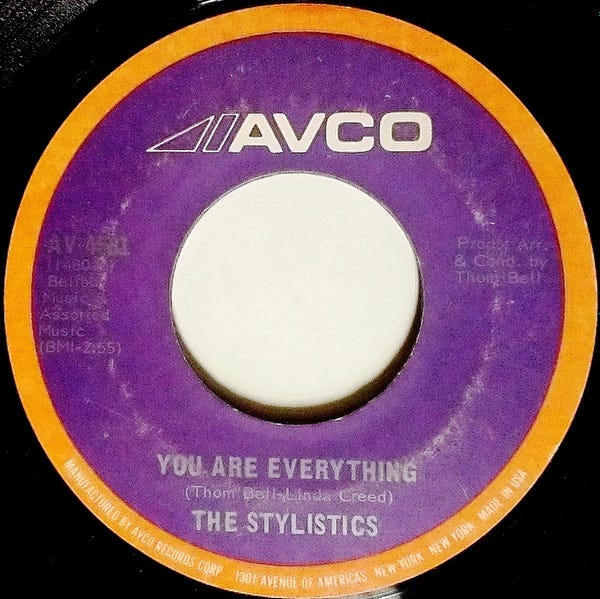
Now many of the records included under this term, and which I’ll mention presently, are exceedingly well-known, probably having racked up more radio airplay than the EWF hits we’ve been talking about: the Stylistics’ “You Are Everything”; Blue Magic’s “Sideshow”; Harold Melvin & the Blue Notes’ “If You Don’t Know Me By Now”. Familiarity with neo-doo wop might diminish your sensitivity to just how unusual and even unlikely its components are. I direct your attention therefore to New York-based group Ace Spectrum’s “I Don’t Want to Play Around”, from their 1974 album Inner Spectrum, which I heard for the first time a couple weeks back and which you have probably never heard. It’s a little like hearing neo-doo wop for the first time, fifty years on:
Now what I understand by the original doo wop is a particularly sumptuous strain of 1950s rock ‘n’ roll, idealized as a street-corner, a capella sound, with vocalized sounds like “doo wop” or “shoop shoop” to indicate the rhythmic pulse. The vocal sound itself is lush and full. The outlook might be upbeat or down — sometimes lovers are gazing at each other in a garden; others, separated by thousands of miles — but the perspective expressed by the singing and the lyrics is generally hopeful, naïve, innocent; imbued with the best kind of ardent, starry-eyed, adolescent devotion.
It’s said there were thousands of doo wop groups across the U.S. in the 1950s, the low barrier to entry encouraging this as an onramp to the rock ‘n’ roll highway. I am especially fond of the one-two velvet-gloved punch of the Heartbeats’ “A Thousand Miles Away” (1956)
and its sequel “Daddy’s Home” (1961), by Shep and the Limelighters:
The two songs span the heyday of doo wop itself, as well as the emotional continuum from heartache to reunited-and-it-feels-so-good.
Arguably, Smokey Robinson’s earliest recordings were as a doo wop singer: the Miracles’ “Depend on Me”, the B-side to their 1959 single “The Feeling is So Fine”, is very much in this vein.
My very favorite doo wop song might just be the genre’s most baroque and overripe example: The Flamingoes’ version of “I Only Have Eyes For You”(1959).
One more doo wop rarity: Wade Flemons and the New Comers’ “Here I Stand” (1958):
Flemons, from Chicago by way of Battle Creek, Michigan, would find himself among the members of the original, 1970s-vintage Earth, Wind & Fire.
It’s exhilarating and novel that a thousand bands would embrace this style of expression in the 1950s, at a particular point in the demographic and social history of the United States. This music works as nostalgia even for those who didn’t grow up with it, because it encapsulates a teenaged vision of romantic love. That a number of African American musical groups would, consciously or not, reclaim elements of the doo wop ethos starting in the late 1960s, however, while equal in beauty to the original flowering of the form, is a little unexpected and kind of strange at first blush.
I’m thinking mostly of Philadelphia groups, mostly on the Philadelphia International record label, mostly under the baton of the brilliant songwriter, arranger and producer Thom Bell, who died in 2022. For the record, many of these “Philly” groups had come from many places. As Bell noted in an interview, “When I walked the streets…we were all paddling in the same direction, in the same environment. And we came out in the same place, just in different spots — every single day… How else can you take the Spinners from Detroit, and the O’Jays from Canton, Ohio, and Wilson Pickett from Prattville, Alabama, and make them part of the Philly Sound?” Not all the Philadelphia International neo doo wop songs are Bell productions. Nor were these all Philadelphia International records; Ace Spectrum’s “I Don’t Want to Play Around” is not, for example; nor is the Chi-Lites’ “Oh Girl”. But they all seem to “paddle in the same direction,” as Bell put it.
There are examples that of Philly Soul records that seem to pick up the mantle from the Heartbeats, the Flamingos, Shep & the Limelites, Wade Flemons & the New Comers. The Delfonics’ “La-La Means I Love You”, the Stylistics’ “Stone in Love With You”, the Futures’ “Love is Here”.
Earth, Wind & Fire would incorporate this neo doo wop sound into theirs in songs like “I Think About Lovin’ You”:
The teenaged ethos is there. What’s odd is that these are not teenagers singing, and probably a lot of the listeners were not teenagers in the early Seventies. These groups seemed to be indulging a taste among listeners for exuberant innocence — even as other Black music explored aesthetic and political revolution. More strikingly, other singers were entertaining revolution because the social and economic conditions of Black life, and American life more broadly, were increasingly straitened: twin recessions in the Seventies, the disappearance of good manufacturing jobs in the cities, and the disillusionment that followed the extinguishing of the lofty aspirations of the Sixties. On this last point, listen to a world-weary Sly Stone at the beginning of the Family Stone’s set at the Isle of Wight festival in summer 1970, already looking back at that brief era of hope:
People believe in a lot of different things. There are universal thoughts, in general. I mean, the people that believe that what’s up is up, down is down, simple things, you know. “It’s very easy to be fair” and “don’t kill nobody”, da da da, blah blah blah, you know, those things. “Hurts if you step on my toe. OUCH.”
Brightening, Sly rouses himself, momentarily: “A lot of things happened in the Sixties. A lot of people STOOD in the Sixties.” He pauses. “A lot of people went DOWN in the Sixties for standin’. That’s unfair—” It sounds like he’s about to say something else, but after a moment, he starts singing, softly, the usually anthemic — but not this time — “Stand!”
That’s the context in which doo wop sounds like something from another lifetime.
Years ago, I reviewed a box set compilation of the Philadelphia International hits, and I hypothesized that the taste for neo doo wop was escapist:
The most characteristic of the Stylistics' songs, with their snail-like tempos, swelling strings and syrupy falsetto vocals declaiming timeless tales of innocent love, sound in this setting like a deliberate attempt to go back to a sweeter time in popular culture, to retreat from a grim and gritty daily reality of layoffs and relationships succumbing to overwhelming stress.
Today, I don’t think it’s an escapist urge; rather, the sweetest of the neo doo wop songs are a minority, amidst a larger group of records, including other songs that tackle fracturing relationships and the decidedly not-teenaged pressures I wrote about above. So many of the great neo doo wop songs are about breakups — not teen breakups after the sock hop — but weary, adult breakups, often without rancor, but plenty of depression.
The Delfonics’ “Didn’t I (Blow Your Mind This Time)” is a bitter kiss off:
The Spinners’ “I’ll Be Around” is a generous kiss off:
The Manhattans’ “Kiss and Say Goodbye” is a stoic kiss off:
Harold Melvin & the Blue Notes’ “If You Don’t Know Me By Now” is about the tired moment on the cusp of a kiss off:
In fact, driven by the incomparable Teddy Pendergrass’s lead vocal (“ten long years we been together”), “If You Don’t Know Me By Now” is the neo doo wop bookend opposite the similarly lush “I Only Have Eyes For You”. (Indeed, the Blue Notes’ pained and laconic “I Miss You” could well describe the aftermath of “If You Don’t Know Me By Now”.)
These are relationships succumbing not just to the ups and downs of romantic relationships, but also to intense social pressure, and — I don’t think I’m being fancifully sociological here — to a fraying social fabric. This is not only my argument: it’s the argument made by the Philly Soul singers themselves when they’re not singing breakup songs.
For example, Harold Melvin & the Blue Notes' (again) “Where Are All My Friends?”, despite its amenable disco beat, is about just what the title says it is:
Pendergrass plaintively cries out “I need a loan!” in between choruses at one point. The O’Jays’ “Backstabbers” — maybe the best Philly Soul record ever — similarly laments the breakdown of trust:
Some of these are probably not neo doo wop songs. But collectively they are of a piece with the slow songs, sweet and not-so-sweet alike. While other singers (and we’ll hear from them next week) took on the fraught social situation more directly, on terms that sounded more conventionally like protest music, neo doo wop registered social protest at the point where social conditions broke hearts.